
Constraints & Complexity
Renaissance Humans, #59
Welcome to the Renaissance Humans Newsletter, where I focus on sense-making and story-telling in the turbulent twenties. The Renaissance (“rebirth,” in French) spanned from the 14th to the 17th century and marked a period of cultural, artistic, and intellectual renewal in Europe. A Renaissance Human fosters curiosity, creativity, critical thinking, and character in a journey of never-ending learning. They cultivate Mind, Body, and Spirit, in service of Community, and oriented to the Transcendentals.
My name is Adam. You can learn more about me here.

When I start seeing something come up over and over again, in multiple domains, I perk up.
Especially when that something is usually though of in a negative light.
Constraints.
Most of us view constraints the same way Dr. Eliyahu Goldratt does. His Theory of Constraints (TOC) is a methodology emphasizing the importance of finding the "system constraint" or bottleneck. By focusing on the weak link in the chain, removing the largest impediment to workflow, individuals and organizations can improve, increase, and/or speed up productivity.
Goldratt offers a five step model: Identify the Constraint (Determine the primary bottleneck that restricts the system's output); Exploit it (Optimize the use of the identified constraint to ensure it operates at maximum efficiency without requiring significant investment); Subordinate Everything Else (Align all other processes to support the needs of the constraint, ensuring that the entire system is synchronized to address the bottleneck); Elevate the Constraint (If the constraint still exists after optimization, take additional actions, such as investing in new resources or technologies, to eliminate it); Repeat (Once a constraint is resolved, return to the first step to identify and address the next limiting factor, fostering continuous improvement).
Take the brakes off, baby! Let’s goooooo!
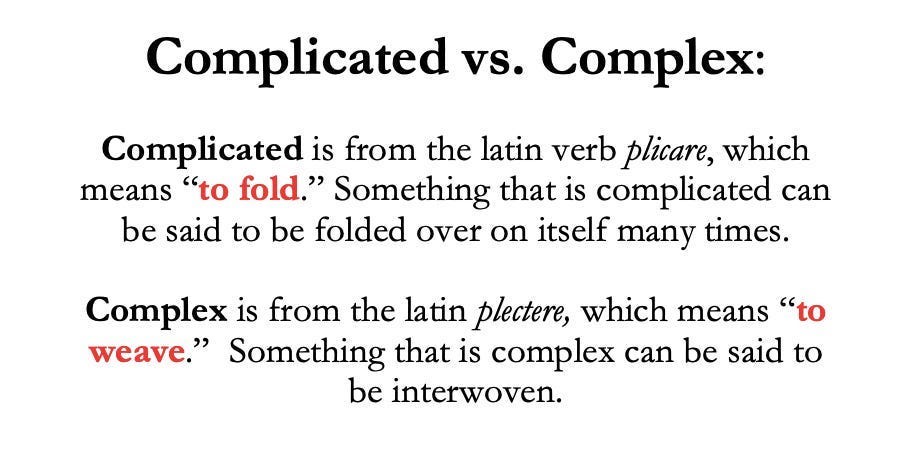
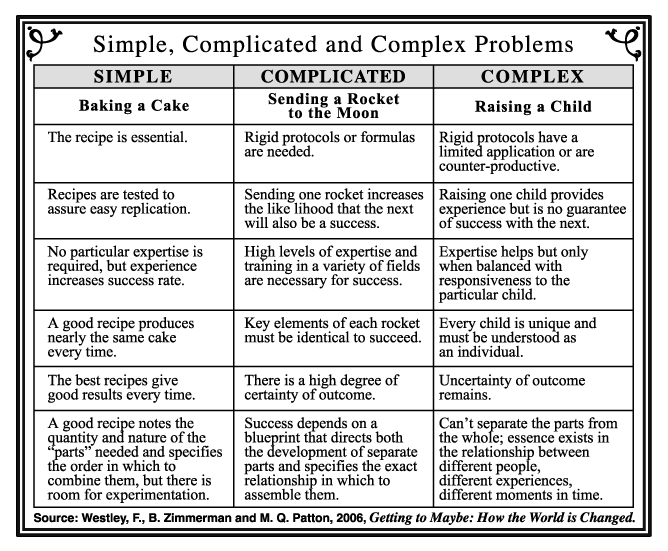
A good model for complicated systems, but not necessarily complex ones. The trick is knowing when to use mechanistic, engineering models (the complicated domain) and when to use organic, holistic models (complexity).
Let’s look at another take on constraints.
G.K. Chesterton, English literary fellow of note, describes their importance with what later be known as Chesterton’s Fence:
There exists in such a case a certain institution or law; let us say, for the sake of simplicity, a fence or gate erected across a road. The more modern type of reformer goes gaily up to it and says, “I don’t see the use of this; let us clear it away.” To which the more intelligent type of reformer will do well to answer: “If you don’t see the use of it, I certainly won’t let you clear it away. Go away and think. Then, when you can come back and tell me that you do see the use of it, I may allow you to destroy it.”
I talked about Alicia Juarerro’s work two weeks ago. Besides context, she focuses on the concept of constraints on complex systems. In Juarerro’s framework, constraints are not simply limitations or restrictions, as commonly envisioned. Instead, they are structuring influences that shape the trajectory of a system. In a dynamical system (most every thing humans participate in), constraints limit the space of possibilities. By doing this, they enable certain patterns, behaviors, and structures to emerge. Juarerro differentiates between two types of constraints— governing and enabling. The big difference is, governing constraints are external and controlling—They dictate behavior. Enabling constraints are internal and generative—They make new behaviors possible. Here is a longer definition of each, with a few examples to get the flavor:
Governing: Imposed on a system from the outside. They determine in advance what can and cannot happen. They are top-down, rigid, and usually predetermined. Governing constraints reduce variability by limiting options. For example, a thermostat governs a heating system. When the temperature falls below a certain point, the heat turns on. The behavior is strictly governed by preset parameters. Traffic laws and building codes are other examples of governing constraints.
Enabling: Internal, relational constraints that increase the system’s capacity to self-organize, develop, or evolve. They don’t prescribe what must happen, but rather guide and shape the space of what can emerge. They enable new behaviors and structures by reducing randomness in a productive way. Enabling constraints are often emergent (arise as part of the process), rather than imposed. The rules of a language are enabling constraints—They limit what sounds or structures are allowable, but in doing so, they allow infinite expression and communication. Another example is the way Jazz musicians riff during a performance. Their improvisation is enabled by the framework of the song’s chord progression.
It’s the same for close quarters combat within a building— simple rules (entry procedures, fields of fire responsibility, priority of threats, etc) foster the creativity to solve complex clearance problems.
Writing contests typically constrain the possibility space— many of them randomly assign genre, length, and specify objects, characters, or actions which must be present in the story.
Instead of making the creative process more difficult, I find my creativity is given a boost by these guidelines.
Constraints cultivate creativity.
Scarcity (a governing constraint on food, money, or other things) is a great driver of innovation. It forces us to reevaluate foundational assumptions in order to find the leanest, pound for pound best solution. The United States Marine Corps is famous for having a much smaller budget than the other services, yet having the most creative, resourceful service members. They have to be.
It’s fashionable today in therapeutic culture to focus on “boundaries”— rules or limits you set for how others can treat, speak, or interact with you. These are constraints on the relationship level—bindings intended to keep such interactions healthy for all parties.
If I give myself no limits on my own behavior, I can simply indulge every desire that floats across my consciousness. I can lose myself to gluttony, lust, wrath, envy, laziness. But I don’t do that— or I try not to, when reaching for my best self.
I constrain my conduct, in pursuit of living as a virtuous human.
I constrain myself to act with justice, courage, prudence, and wisdom (The cardinal virtues). It’s not always easy to act in accordance with such constraints. Most of the time, it’s hard. I don’t always succeed.
Faith and philosophical traditions of the world create these constraints for human and group action. Think of things like the Ten Commandments in Christianity, the Eightfold Path in Buddhism, or the Five Pillars of Islam. These traditions seek to guide human conduct, with the goal of a helping us come into alignment/accord with the divine, the universe, reality, god—however you choose to define that which exists outside you.
These strictures get suffocating when taken too far. There are plenty of horror stories from humans within these systems. Too many constraints are stifling, but too few can be just as damaging, for both humans and their larger groupings.
We need constraints. We don’t always want them, but they create the conditions for flourishing and flow.
Sheesh, Adam! Too much good stuff packed into this one to cover adequately. Briefly:
I appreciate your clarification of the difference between complicated and complex. I use those as synonyms. No more.
The value of self-imposed constraints is well presented.
I'd like to require the DOGE boys to confront a Chesterton's Fence before gaining entry to any government program or system.
Interestingly enough, I just wrote about constraint when it comes to Innovation today. Great minds think alike! 😆 Constraint is an interesting quandary, especially in complex situations. Some people try to constrain by arguing in, but they'll never solve a problem. Others get lost in the complexity and don't know how to bound it.
This past week, I've been putting constraints on the JADC2 Kill Web problem, which is hyper-complex, and yet, these constraints are as much forcing people to look at the whole system, the ToC approach, as it is focusing that attention on a series of core capabilities.
And I love Chesterton's Fence!