
On Quitting
Renaissance Humans, #78
Last month, I quit.
I dropped out of my PhD program.
I’d completed exactly half of the academic coursework, still had a year left, in addition to writing the dissertation, which normally takes 1-3 years by itself. My PhD cohort was a wonderful group of people—fellow thinkers on a similar intellectual journey towards specialized knowledge. I loved the university and the professors, and we read some great books and essays over the last year.
It was a tough decision—to quit something I really enjoy doing and believe I am decent at.
In the United States military, Naval Special Warfare has a training pipeline renowned for the number of quitters it produces. There, quitting is usually equated with both personal and mission failure.
Each SEAL training class portages the infamous bell around Coronado Island with them during Hell Week, a sacred relic employed so quitters may herald their failure to the world with dramatic fanfare.
Never quit, never surrender, never retreat, is the implicit lesson. For most endeavors, adopting a default posture of never quit is a good thing. Hard work and perseverance carry the day the majority of the time. Here’s Admiral McRaven talking about “ringing the bell”:
But is the good Admiral right that we should never ever ring the bell?
Or are there scenarios where quitting is something we should contemplate?
Poker professional Annie Duke’s second book came out in 2022. She opens it by discussing common perceptions about quitting—how we typically contrast “Quit” with “Grit”—sticking with a given discipline or subject.
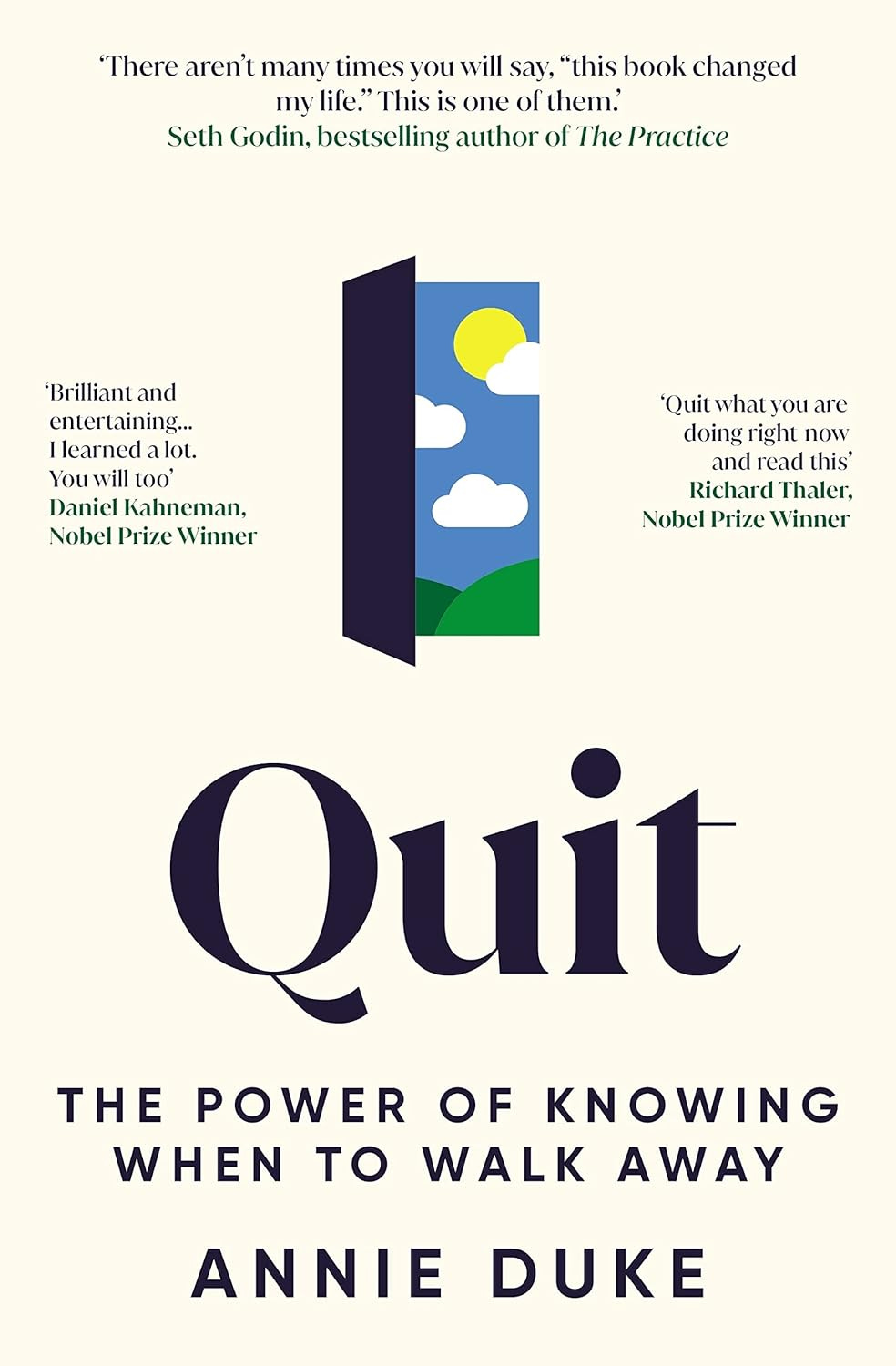
Her point is to treat quitting as a decision skill—a way to maximize long-term outcomes by stopping the wrong things sooner and freeing up time, money, and attention for better “bets.” She has a few recommendations to do this:
Judge decisions by process, not outcomes. In uncertainty (read: poker or life), you can make a good choice that ends badly, or a bad choice that works out. Focus on expected value (EV, a game theory & poker term relating to size of payoff and probability of getting that payoff) and whether new information changes it.
Think about “monkeys and pedestals.” The example from the book is, you’re trying to create a “monkey juggling flaming torches” performing act. You do need to procure/build a pedestal, but that is relatively easy, compared to training the monkey to juggle. So, focus on the hardest, most complex part of the problem first—there’s no sense getting a pedestal if you can’t overcome the bottleneck of training the monkey.
Duke articulates the following process:
Set a timeline for periodically reevaluating the effort.
Define kill criteria—what objective data, by when, would make you stop?
Run a pre-mortem (how could this fail?) and an “anti-goal” (what failure are you avoiding?).
Track opportunity cost—what higher-EV option would you pursue if you quit?
Normalize quitting by seeking outside perspectives (to counter sunk-cost and status-quo bias).
Among others, Duke discusses professional mountain climbers and the importance of pre-set turn-around times—a key factor in saving numerous lives1. She also looks at comedian Dave Chappelle walking away at the height of his Comedy Central popularity. Duke’s overall message is rather than a character flaw or failing, quitting can be a path to better outcomes.
I won’t do a deep dive into the reasons why I quit the PhD, but the main one is so I can focus more fully on reading and writing. If I had to choose between having a PhD or writing 2-3 additional novels, I would choose the novels. I still leave the door open to return to the degree program at a later date, but I enjoy the autodidact’s path. I like following threads of inquiry wherever they lead, and that is best done outside of a structured curriculum.
Since age ten or so, I’ve only wanted to be two things—A commando and a writer. I am simply attuning to the path I caught a glimpse of at a young age.
It is entirely right and proper to close with the immortal words of The Gambler himself:
You got to know when to hold 'em, know when to fold 'em
Know when to walk away and know when to run
You never count your money when you're sittin' at the table
There'll be time enough for countin' when the dealing's doneEvery gambler knows that the secret to survivin'
Is knowin' what to throw away and knowing what to keep
'Cause every hand's a winner and every hand's a loser
And the best that you can hope for is to die in your sleep.
Currere Certamen Tuum / Run Your Race
In Naval Special Warfare, we call these “drop dead” times—ignore them and risk mission failure or death.
Informed and tactical quitting is frequently overlooked and you’ve explained the importance of it in making sustained progress. You’ve made a difficult, but valuable decision. Thanks, Adam
I quit mine after the exact same amount of time. Best thing I did.