
Polymodern Warfare
Renaissance Humans, #87
A recurring theme of this newsletter is to discuss the moment we’re in—what big history thinkers like Peter Turchin call the Turbulent Twenties—and how to be a resourceful, flourishing human amidst this tumult. A Renaissance Human, comfortable in a variety of different situations.
I want to talk about some possible reasons why the internet, politics, and the geopolitical realm seem so confused, chaotic, and riven with conflict (I just can’t stop with the alliteration. It might be some kind of disease).
A basic familiarity with these concepts is of value to everyone. They provide useful frameworks for examining events—whether some random viral post on social media, the hellscape of US domestic politics, or the titanic shifts on the geopolitical scene.
War (the state of) and warfare (the method of) are immense drivers of societal evolution and human innovation, as unpleasant as that is to consider. War is policy by other means, as old Carl said.
First, what is Polymodernity? Framing the Moment
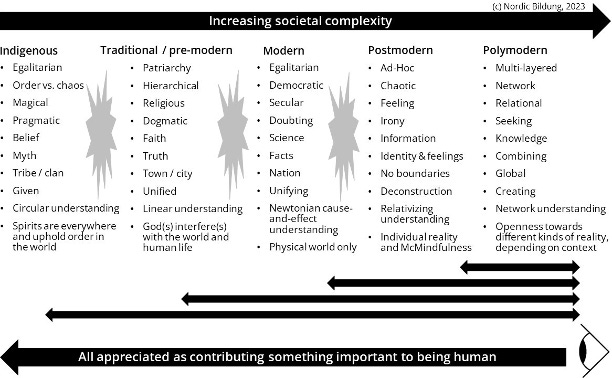
In Polymodernity: Meaning and Hope in a Complex World, author Lene Rachel Anderson surveys human history and lines out several eras, based on general worldviews—what she terms “cultural codes”. This is always dangerous, as you open yourself up to critique from historians and others about painting the past with too broad a brush. Yes, the reality is more messy, with no neat boundaries between these codes. But let’s take a quick stroll through the case Anderson makes. She divides the cultural codes in the following manner:
Indigenous — Small, kin-based communities; animistic/spiritual worldviews; cyclical time; deep place-based belonging and ecological attunement. Strengths: cohesion, sustainability; Limits: low scalability, limited abstraction.
Premodern — Agrarian civilizations; organized religion and tradition; hierarchical order; meaning via shared myths/rituals. Strengths: stability, duty; Limits: dogma, rigid roles.
Modern — Enlightenment rationality, science, industry, markets, nation-states; rights-based individualism and universal rules; linear progress. Strengths: prosperity, technology, rule of law; Limits: alienation, externalities, disenchantment.
Postmodern — Critique and deconstruction of grand narratives; pluralism, relativism, irony, identity focus; media/symbol savvy. Strengths: inclusion, skepticism of power; Limits: cynicism, paralysis of meaning.
Polymodern — A both/and synthesis that integrates the best of indigenous, premodern, modern, and postmodern into a fifth code for a complex world—re-coupling ecological belonging, shared meaning, scientific rigor, and critical reflection (often linked to her Bildung/emphasis on character formation). The goal is to foster meaning, responsibility, and regenerative systems.
Andersen originally framed this last integration as metamodernity, but later shifted to polymodernity to distinguish her work from metamodernism in the arts, while keeping the four cultural code integration. She asserts the pattern over time is one of increasing social complexity.
Many thinkers make a similar claim about the increasing complexification of reality; it seems to be an emerging consensus.1 Effective reality navigation is at core about learning/processing information from the environment effectively, when we define information as that which allows us to persist in time.
Indeed, we can look at the defining question of our age—how should humans organize politically—democracies or autocracies—as an information processing question. If what we know about systems thinking is true, then even with all their messiness and warts, open systems (democracies) should still be superior to closed ones (autocracies), which are made brittle by their closed nature. The danger is AI and associated surveillance technologies can finally make real Bentham’s Panopticon in a way never before possible.
Generations of Warfare
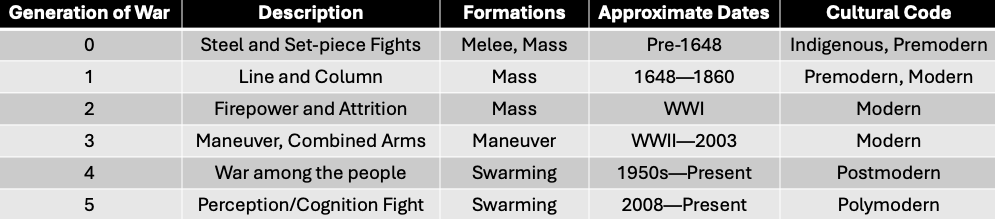
The “generations of warfare” notion is relatively new—coined in 1989 by William S. Lind and a group of military thinkers writing in the Marine Corps Gazette. These relate to modern warfare—meaning after the peace of Westphalia in 1648, which created the nation state paradigm as we know it. As such, I’ve added Zero Generation Warfare (0GW) to denote conflict prior to 1648.
Like we saw with Anderson’s framework above, none the following generations perfectly describe reality— we know all models are wrong, but some are useful, as Taylor Swift George Box said.
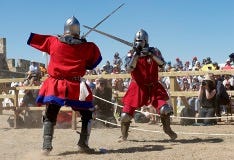
0GW: Employed by tribes, city states, and empires, dominated by close combat, shock, and simple projectile weaponry; limited logistics and command, ritualized or seasonal fighting. These are mainly melee and massing type battles.2 They did use lines, maneuvering forces, and formations such as phalanxes, but it’s pre-industrial at this point.
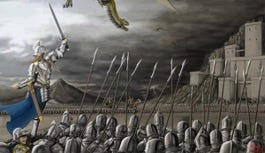
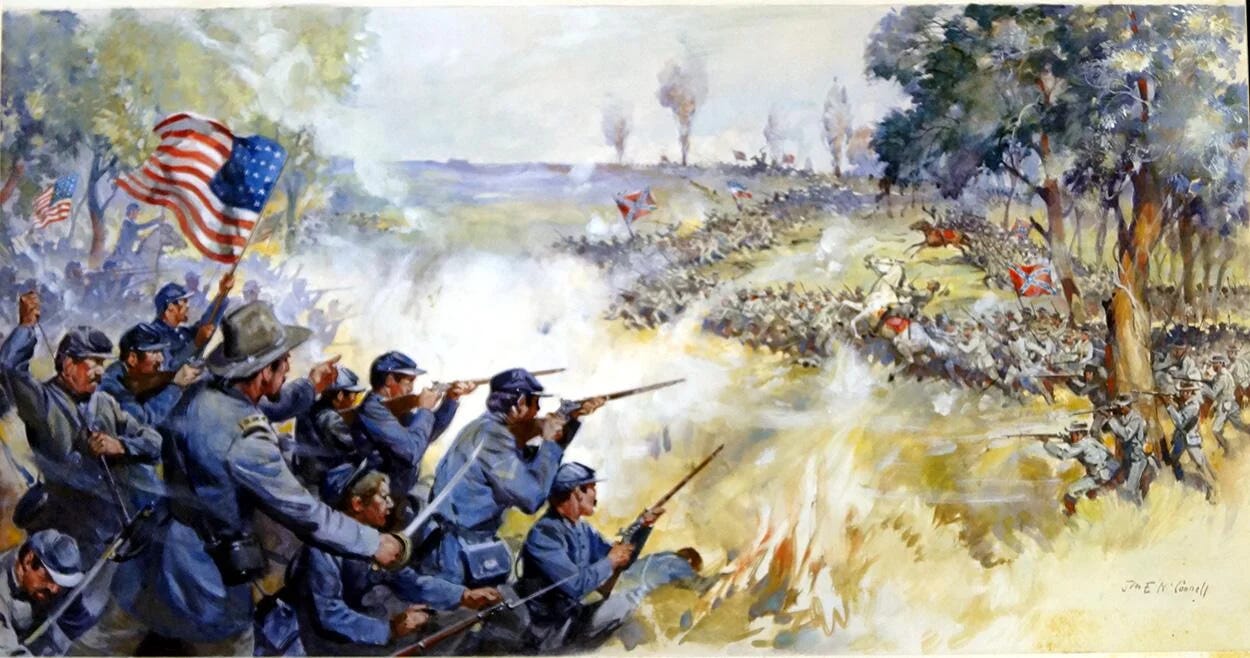
1GW: Post-Westphalia to mid-19th century, this generation begins the industrialization of the war process—massed ranks with smoothbore muskets and artillery. Formations are line and column, using linear drill, close-order volley fire, and decisive set-piece battles. Think Napoleonic wars and the US Civil War. This generation produces things like uniforms, saluting, emphasis on rank hierarchies, and enforcing a military culture of order.
2GW: Late 19th to mid-20th century warfare that relied on rifled artillery, machine guns, and trenches, all controlled by centralized command—World War I. The French Army developed a doctrine that used massive, mostly indirect artillery fire to wear down the enemy—“the artillery conquers, the infantry occupies.” Battles were run with strict, detailed plans that synchronized infantry, tanks, and artillery. Orchestra, not jazz band.
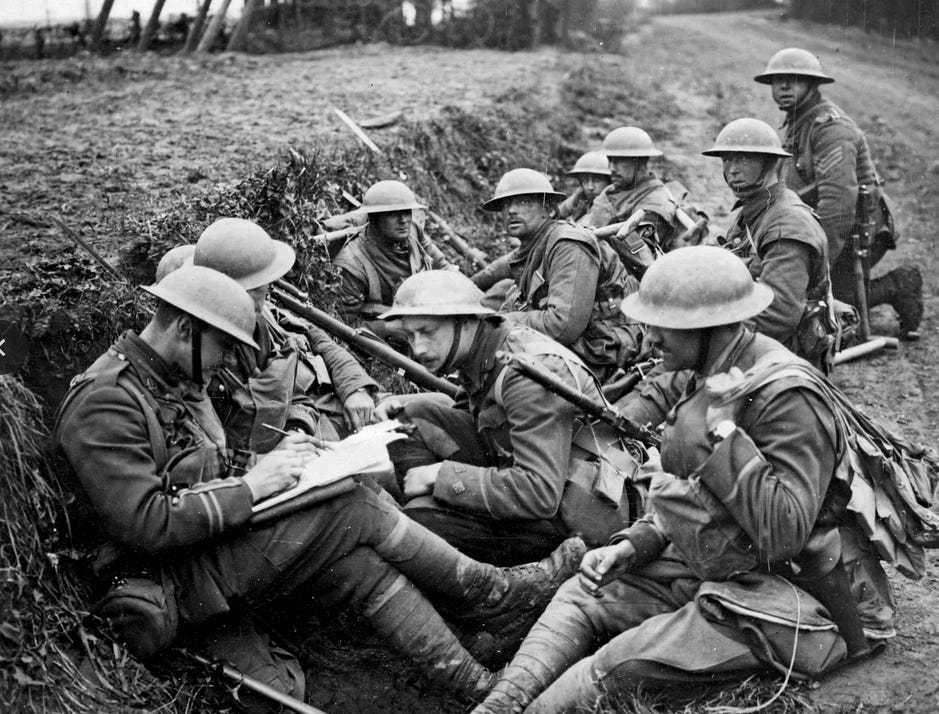
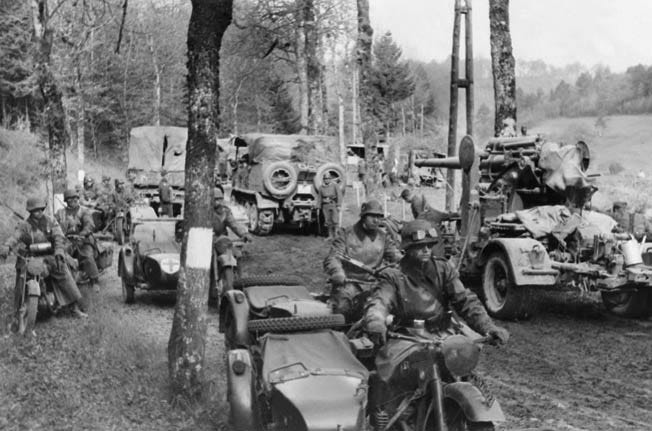
Brief interlude here to say at the end of WWI the Germans did a good deal of innovating, but their insights in combining movement and firepower came too late to help them in that conflict. It did lead to their spectacular early success in the next war.
3GW: This style of warfare began in earnest during World War II. Instead of slow, grinding battles, forces used speed, infiltration, combined arms, and decentralized decision-making (mission command) to disrupt the enemy. It focused on surprise and psychological shock rather than pure firepower. Tactically, the goal was to bypass enemy front lines, strike the rear, and collapse the force from behind—“bypass and collapse” instead of “close with and destroy.” War stopped being about holding a rigid line and became about movement and disruption. This is also known as maneuver warfare. It’s the type of war the United States really wants to fight, because we think we’re good at it. But our adversaries have noticed, and they don’t want to fight this way—something David Kilcullen documents nicely in The Dragons and the Snakes.
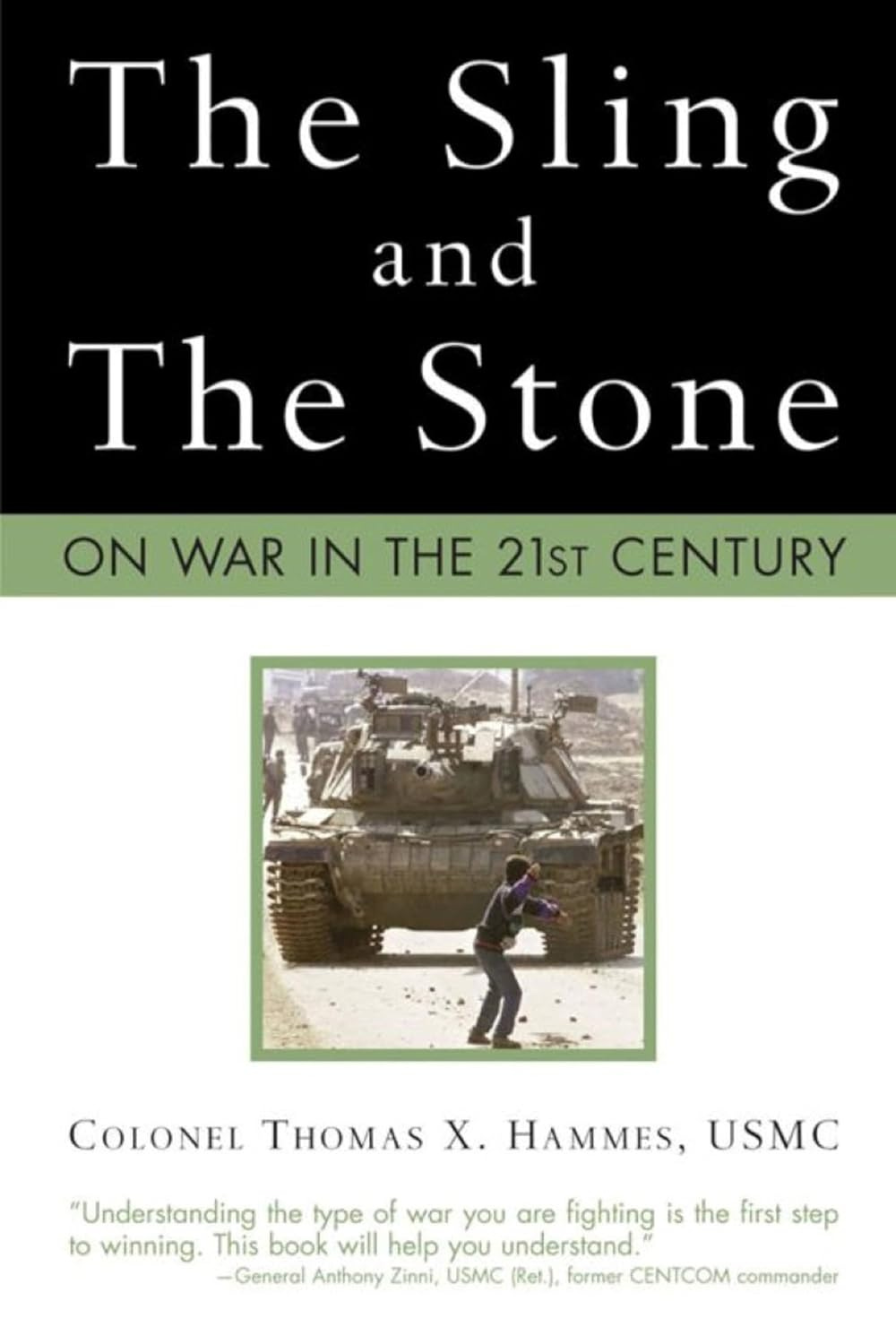
4GW: This generation is often called irregular warfare or “war among the people.”3 It emerged around the 1950s–1970s and features non-state or proxy groups using insurgency, terrorism, lawfare, and media operations. The fight is less about territory and more about legitimacy and narrative, so decisive battles are avoided. The state no longer holds the monopoly on war—uniformed militaries face off against groups like al-Qaeda, ISIS, Boko Haram, Hamas, Hezbollah, al-Shabaab, and the Houthis. Culture, law, information, and media become weapons, and the battlefield blends into society. The goal isn’t to destroy the enemy’s army, but to undermine the state’s credibility and win over the people. More jazz improve vice orchestra.
So, we begin with tribal and premodern pitched battles without firearms (0GW), and shift to nation-state combatants and ordered forces with muskets and cannon (1GW). We transition to industrial firepower and attrition (2GW) in the trenches of World War I, and combined arms maneuver warfare (3GW) in World War II. Following that, conflict morphs to decentralized political-psychological conflict (4GW). Each builds on the others in an accretion of tactics and techniques.
I should preface the next bit by noting Lind himself does not agree with the concept of 5GW. He maintains what we see today is simply a manifestation of 4GW. I believe this is similar to people who look at metamodernism or polymodernism and believe it’s just more postmodernism.
This is what I think about those people, and serves as a good segue into 5GW:



Fifth Generation Warfare
5GW: The new hotness, like Derek Zoolander, so hot right now. 5GW is conducted primarily through non-kinetic military action—misinformation, cyber attacks, social media shitposting, and emerging technologies like AI and drones. I place the start point for this generation around 2008—the chocolate and peanut butter nonlinear combo of smartphones and social media. Fifth generation warfare has been described by independent scholar Daniel Abbott as a war of “information and perception”.4 Like previous generations, this form transcends and includes the others, Ken Wilber style—it might feature tribal skirmishes (0GW), trench-style warfare (2GW), blitzkrieg maneuver (3GW), networked insurgents (4GW), in addition to actions in the cognitive and digital realms (5GW).
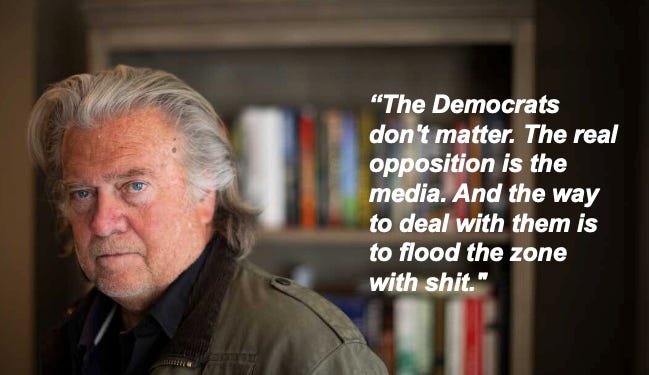
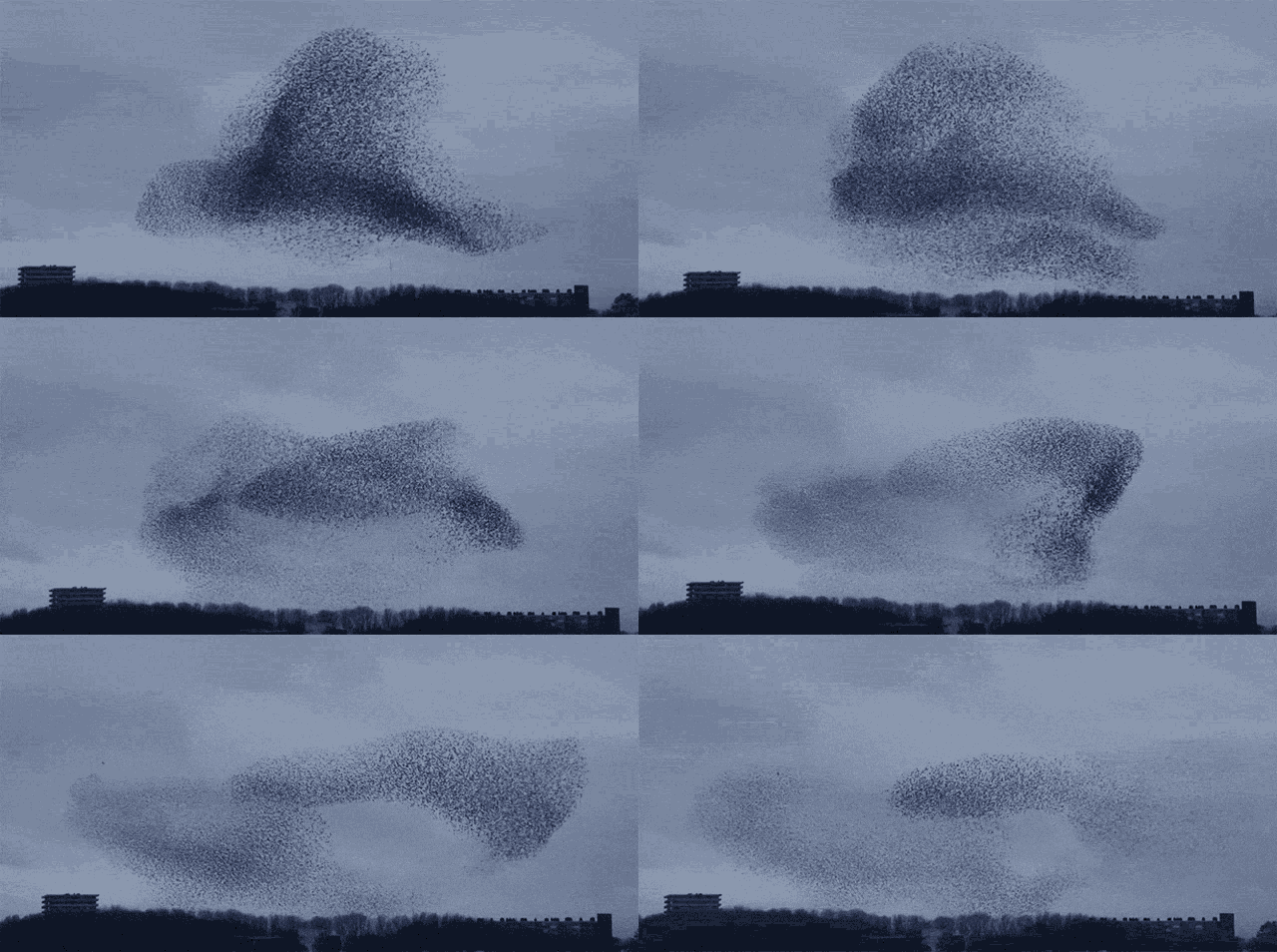
This is where we see techniques enabled by emerging tech percolate into the conflict space— Sock puppets, Troll Farms, and Bots that influence narratives on social media platforms. The goal is shaping perception before a shot is fired, and making attribution of the methods employed difficult, if not impossible. Swarming is heavily employed in 5GW.5 We see it reflected in the physical world in drone swarms and Iranian gunboats, and online in the form of social media dog-piling or getting ratioed.
While propaganda is as old as human societies, Mimetic Warfare targets the human tendency to imitate by seeding behaviors, symbols, narratives, or emotional contagions that others unconsciously copy, allowing conflict to spread culturally and virally through an information ecosystem rather than purely through force. Force is a component, but in much smaller amounts than previous generations. Instead of defeating the enemy directly, memes infect their identity, values, and social dynamics, causing them to replicate the very patterns that undermine their own cohesion, or strengthen yours. Memes are a critical component of 5GW. I put this Real Time With Bill Maher clip of Aidan Walker discussing the impact of memes in last week’s post, but it’s relevant here also:

The danger of this frame is, you can start to see enemies and threats in every shadow. Is that edgy post on X just someone venting anger and frustration, or something more insidious? Is that conspiracy theorist doing what crazy uncles always do, or is it part of a larger campaign by our adversaries? Hard to tell. That’s the point, the creeping sense of unease and shoulder-shrugging bewilderment. Remember Hanlon’s Razor—Never attribute to malice that which can adequately be explained by stupidity. It’s easy to slide your way into conspiratorial thinking here, and think there is “a plan” when it’s just some emergent behavior of the system. Sometimes what we think is a 5D chess by our adversaries is just a random thing they did or that happened. So you’re in a carnival funhouse here.
Putting It Together
Polymodern Warfare (PW) provides a new way to frame conflict in this decade. 5GW centers on cognition, and focuses on nonattribution of activity. PW is a wider lens to understand the space of conflict as multi-paradigm. It asks which cultural codes, institutional rules, and technological eras will be most persuasive for each target and then employs the tools (kinetic, legal, economic, tribal, memetic, cyber, AI) so they resonate across those publics and timescales.
Success looks like cross-domain resonance (sea, air, land, cyber, space, and the emerging cognitive realm)—actions and narratives that align across diverse constituencies and tech stacks to produce nonlinear effects. The Chinese and Russian analogues for this type of warfare can be found here.6
So What? Implications for the Average Human
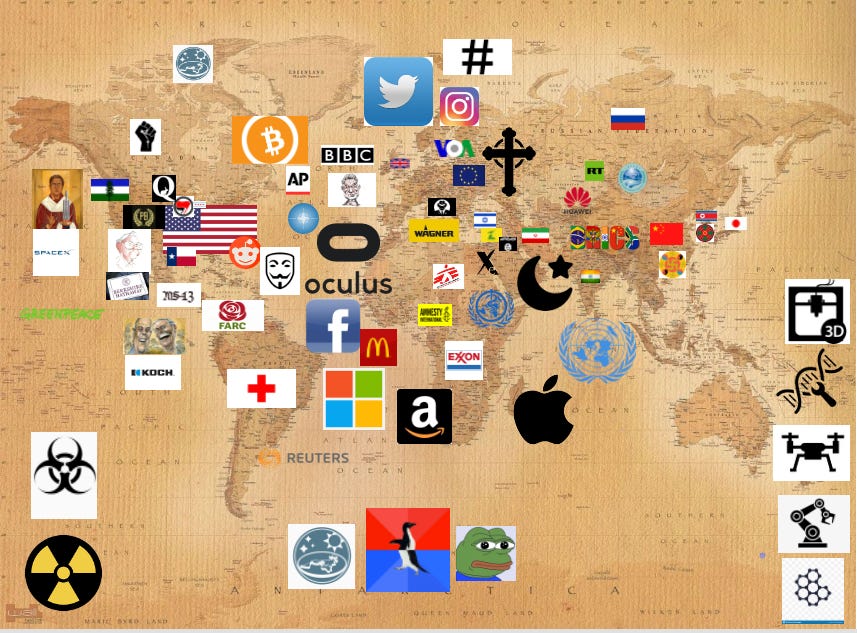
Let’s go back to my weird little map at the top of this post. What I am seeking to convey is that the long peace of Westphalia is breaking down. We’re shifting to a multipolar world—the most unstable and prone to miscalculation.7
Or perhaps, as Peter Limberger notes, it is better described as multiplex, a term popularized by International Relations scholar Amitav Acharya. Acharya’s multiplex world order theory argues global power is becoming decentralized, with multiple actors—states, regions, institutions, and networks—sharing influence instead of a single hegemon. This system resembles a multiplex cinema, where many interconnected stories play at once, reflecting pluralism, regional autonomy, and complex interdependence rather than hierarchical control.
For most of human history, all sorts of different-sized actors exerted agency in the world. Wealthy families, companies, city-states, religious organizations, tribes, leagues, and empires all fought each other.
Then, after 1648, conflict increasingly came to be controlled at the nation-level. That level became the unit of analysis for most everything that happened in the world. Decades of emerging technology has begun to change that. Most of us will agree that the advent of the internet, smartphones, social media, and AI represents an epochal shift, on the order of the Gutenberg press. The nonlinear impact of this tech is a dramatic shift of power and agency, away from the nation state model, towards sub-state (smaller than a state) and supra-state (larger than a state). Here are some examples:
Sub-state:
Individuals like Elon Musk, whose decisions impact the battlefields of Ukraine and American elections
Small networks like the Subreddit r/WallStreetBets that caused a market crash in 2021 with Gamestop stock.
“Non-state actor” criminal and terrorist groups like MS-13 and the Houthis. The Houthis in particular dramatically disrupted the world economy by threatening cargo vessels in the Red Sea in 2023.
Supra-state:
Multi-national companies like Amazon, Exxon, or BlackRock.
Economic alliances like BRICS.
International networks of activist groups, like Extinction Rebellion or the recent Gaza Flotilla, and Non-Governmental Organizations like Doctors Without Borders.
This is what I’m trying to depict in the above image—the growth of new actors exerting increasing agency in the world. Of course, the nation state has been around for awhile (See Taleb’s Lindy Rule), and it will not give up primacy without a fight. But in many ways, what’s happening is a reversion to the pre-Westphalia mean, enabled by technology. Trust, and by extension power, moves to sub-state and supra-state entities. Think about how all these former big media figures are now writing on Substack, or musical artists are finding ways around giant monopolies like Spotify with more decentralized platforms like Bandcamp. This is agency flowing down to the individual from the institutional level. Guild are coming back, babee!
This new world contains legacy dangers (Climate, Nukes, Biological weapons), while adding emerging tech (AI, Gene-editing, Additive Manufacturing, Nanotech) and these newly-empowered groups to the party. What could go wrong?
At least three implications follow:
Understand that when you, random citizen, are online, you are in a conflict space, enmeshed in a battle for perception and attention. You may not be interested in this form of conflict, but it most certainly is interested in you. From your mind to domestic politics to international relations, various actors are shaping perception and cognition in a very Hobbes-ian conflict of all against all.
Media literacy is critical. SIFT is one method—Stop, Investigate the source, Find better coverage, Trace claims, quotes and media to the original context. Mark McGrath | OODA Strategist has a method to approach this information ecosystem. In his words:
The 5T Protocol exists for one reason: to give you orientation in an environment designed to strip it from you. It’s not a commentary tool. It’s a survival tool. It doesn’t tell you what to believe. It shows you how belief is being manipulated. Here’s how it works.
TERRAIN – What surface issue is being used to anchor the conflict? What landscape are they trying to map your attention to?
TARGET – Who is being cast as the villain, the problem, the virus in the system? Who is being sanctified as the hero?
TONE – What emotion are you being pushed into before you even think? Fear, guilt, rage, shame?
TROPES – What recycled storyline is being deployed to make the narrative feel familiar, inevitable, or virtuous?
TACTICS – What actions are being justified once you’ve accepted the story? What policy, censorship, punishment, or reward is being introduced under moral cover?
Technology is not neutral. It reconfigures every relationship, alters our perception of reality, our very consciousness, and creates second and third order effects which are challenging if not impossible to anticipate. Thinkers who are valuable in this space are Neil Postman, Jacques Ellul, Walter Ong, Harold Innis, and Marshall Mcluhan. Mcluhan’s Tetrad model in particular is a valuable framework with which to analyze a given piece of tech and how it will change reality.
The best way to navigate this era is a commitment to epistemic humility—what we think we know about a given situation—and lifelong learning. Physically strong, resilient to the stressors of the environment. Mentally strong, discerning amongst the firehose of falsehoods online. Spiritually strong, recognizing that value is real, and worth striving for. To match the complexity of the world with internal complexity, as it unfolds.
Currere Certamen Tuum / Run Your Race
Human societies have always been complex, but what’s different in this era is the interconnectedness of individuals, societies and the larger world through advances in technology. That, and our abilities to terminate our species in several different ways. Some of the thinkers pointing to complexification include Ilya Prigogine, Stuart Kauffman, Alicia Juarrero, Kevin Kelly, Bobby Azarian, and too many more to list here.
Melee fighting features linear face-offs and easily dissolved formations. Communication technology was limited to eyes, ears, waving, shouting. Examples would be Persian empires, feudal battles, WWI dogfights, and tribal conflicts. Massing can be defined as thick formations of soldiers for specific set-piece battles. They employ drilling routines to create cohesion and discipline. Communications technology includes written orders, semaphore-type signaling systems. Examples would be Greek phalanxes and Medieval charges of knights on horseback.
The US Army and Marine Corps has long experience in some of these types conflicts, at the end of the 19th century, such as the military interventions in Central and South America. All models are wrong.
Another term bandied about is Cognitive Warfare, a subset of a larger category called Information Warfare. This bears similarities to Psychological Warfare. It is the deliberate targeting of how individuals and societies perceive, think, decide, and make meaning, aiming to shape the cognitive domain itself rather than just influence emotions or behavior. The term emerged in the 2010s—especially within NATO and Chinese military writings—as warfare expanded into information ecosystems shaped by social media, AI, and networked society. While psychological warfare traditionally seeks to influence morale, emotion, and behavior through persuasion, intimidation, or deception, cognitive warfare goes deeper and broader: it seeks to alter the decision-making environment, attack sense-making processes, exploit cultural narratives, and erode trust in shared reality. While psychological warfare manipulates what you feel and do, cognitive warfare seeks to shape what you believe is true.
Swarming can be defined as many small, networked actors (human or autonomous) striking from multiple directions simultaneously, physically or digitally, without centralized command. Think about the mobs that gather on social media to cancel someone. Or a flash mob. Their attacks are designed to disrupt cohesion of adversary. Swarming has been around for thousands of years, but smartphones and social media enable the tactic to be employed at scale. In nature, we see bees, ants, mosquitos, flies, sharks, wolves, hyenas exhibit swarming behavior. German U-Boat Wolfpacks in WWI/II used swarming to overwhelm allied shipping and naval vessels.
Unrestricted Warfare is a 1999 treatise by two PLA officers, Qiao Liang and Wang Xiangsui, arguing that in an era of globalization states can—and should—use all instruments of national power (economic, legal, cyber, information, terrorism, etc.) alongside or instead of conventional force to compel adversaries and exploit their vulnerabilities. The book’s core claim is that technological or military superiority can be offset by creative, cross-domain campaigns that treat war as “unrestricted” by traditional military bounds. Though widely read and influential in Western analyses of Chinese strategy, scholars caution that the work is an intellectual provocation rather than an official, single-source PLA master plan—its prescriptions have been debated, adapted, and sometimes overstated in outside commentary.
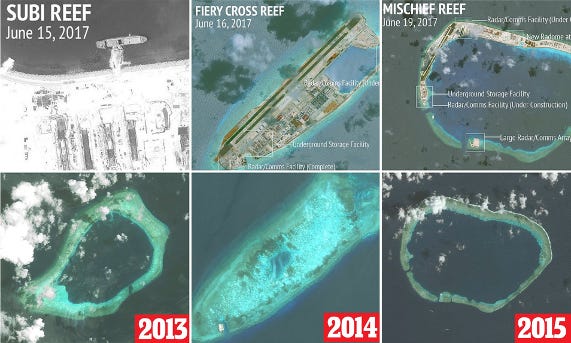
China’s Three Warfares is an official PLA information-operations framework—Public Opinion Warfare (media/influence), Psychological Warfare (undermine will and decision-making), and Legal Warfare (lawfare: using legal/legitimacy claims and institutions)—formally codified in PLA political work guidance in the early 2000s and taught across PLA professional education. The approach purposefully blends media, legal, and psychological tools to shape narratives, confer permissive legal or political conditions for coercion, and erode an opponent’s cohesion and resolve without firing conventional weapons. Examples include China’s efforts in the South China Sea to engineer “facts” on the ground through the creation of islands out of reefs.
Active measures (aktivnye meropriyatiya) is the Soviet/Russian set of covert, deniable political-influence tools—propaganda and disinformation, front organizations, forgeries, clandestine funding of favorable movements, and at times sabotage or violent covert actions—used since the Soviet era to shape foreign politics and perceptions in ways that advance Moscow’s strategic objectives. In the Internet age, this includes cyber-enabled influence networks, troll farms, and targeted social-media amplification while preserving a tradecraft of plausible deniability.
Reflexive control is a Russian conceptual approach to shaping an adversary’s decision-making by feeding them tailored information, deceptions, or options so that they choose an outcome favorable to the manipulator—i.e., you don’t coerce choices directly, you structure the opponent’s perceived utility sets so their rational response plays into your plan. It draws on cybernetics and psychological theory, is applied through deception, feints, disinformation, and tailored provocations, and is prized because it can produce strategic effects with high leverage and plausible deniability when executed with good intelligence about the target.
Unipolar refers to a global system dominated by a single superpower that sets the rules and faces no true peer competitor. Bipolar describes a world divided between two dominant powers or blocs whose rivalry shapes international order (e.g., the U.S. vs. USSR during the Cold War). Multipolar means power is distributed among several major states or coalitions, creating a more complex and fluid balance of alliances and competition.
A great piece tying together many threads. I like the 5GW concept because it wraps up what we've all been noticing — the melding of "peaceful" political contests and "violent" military ones into a nonstop meta conflict in which there are no clearly deliniated sides and borders, few declarations of war, and only fluid ideologies. States are not unified, but a heavy mass of ideologies uncomfortably stitched together by geography and constitutions. The world is getting less understandable and we must be humble to thrive in it.
I do wonder if we should see this evolution as a new level of complexity or a disintegration/entropic movement. I'm tempted to see a thousand statlets competing and coexisting where once a monolithic empire reigned as added complexity, but their squabbles may create disorder and loss along some avenues. When the Roman empire fell, its successor states first declined before competition and divergence drove increasing complexity.
Another aspect is that all this is taking place against a background of an aging planet. The demographics of once-dynamic civilizations like Italy, Germany, Japan, Russia, and China are already declined and seem unlikely to recover. The old are less dynamic. They consume less, create less, are more settled in their views, and as their economies and opportunities slow, further opportunities for radicalism will appear among them.
But then again, even this is uncertain. The trifecta of AI/automation, and impressive anti-aging treatments may throw all in a loop.
Nice work.
Might need to reread this a few times ; bravo mate.
I see the collected essays of AK on my bookshelf as being indispensable, interesting, important, oh shit I’ve caught the dis-ease
Flow well