
Attunement
Renaissance Humans, #100
Do we have ideas, or do ideas have us?
Several summers ago, I was deep in revision for The Infernal Tower when I found myself unable to stop thinking about Attunement, or what I’ve come to call the A Frame. I wrote a three-part series totaling over 10,000 words, more or less against my conscious desires.1 This is a super-wooish declaration which may be off-putting, although it has the benefit of being true. I just wanted to write fiction, but I had to put that on hold.
Because this idea had me.
Over on Frogman Fiction, I talked about the similarities between storytelling and the chaotic bifurcations in many dynamical systems. How story itself is a technology used to come into correspondence with a complex and overwhelming reality.

It is this come into correspondence with a complex and overwhelming reality the A Frame focuses on. It is part artistic feeling-into-things, part scholarly synthesis of the domains of neuroscience, psychology, complexity, systems thinking, and others.
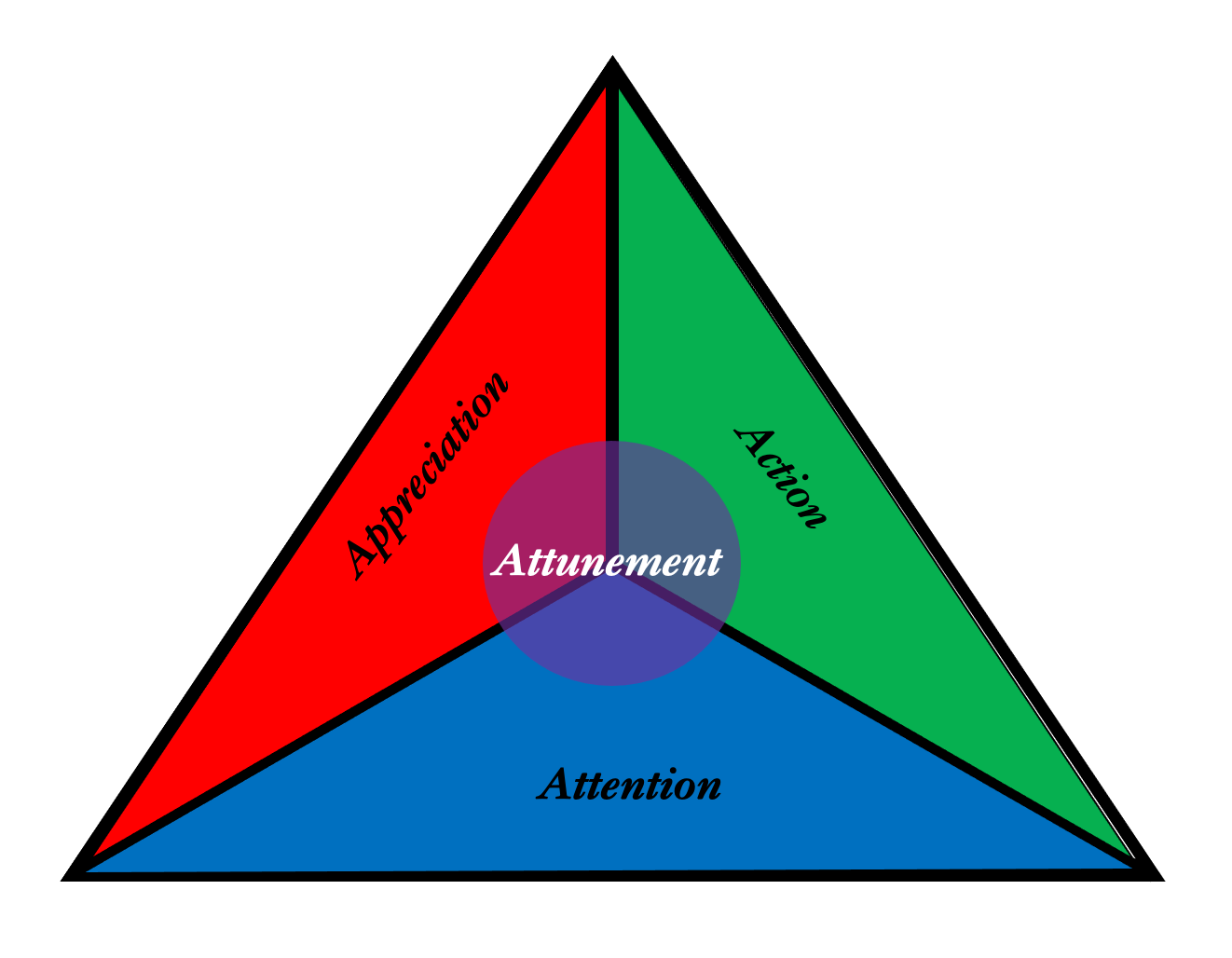
It describes how a human agent skillfully exercises agency within an arena by cycling through attention, appreciation, and action.2 The agent attends to salient features of the environment, appreciates their meaning by integrating perception, context, emotion, and judgment, and acts in the world.
These three modes shape one another. Action changes what we notice (attend to); what we notice changes what we value (appreciation); what we value changes how we act. Over time, this dynamic loop leads to attunement—a state of fittedness, flow, and optimal grip on reality—enhancing adaptability and engagement amid complexity and change. This model is both descriptive and aspirational: it shows how humans adapt, and offers a way to do so more wisely.3
Why Attunement?
In common usage today, attunement means emotional and relational alignment—”tuning in” to yourself or another person. I mean that, but also a deeper connection to reality itself. Attunement is what happens when humans are able to separate signal from noise.
I have nicknamed The A Frame Spiritual OODA, because I see it nesting inside the OODA Loop as a deeper pattern. It sits on a foundation of Boyd’s work and owes a great deal to his efforts.
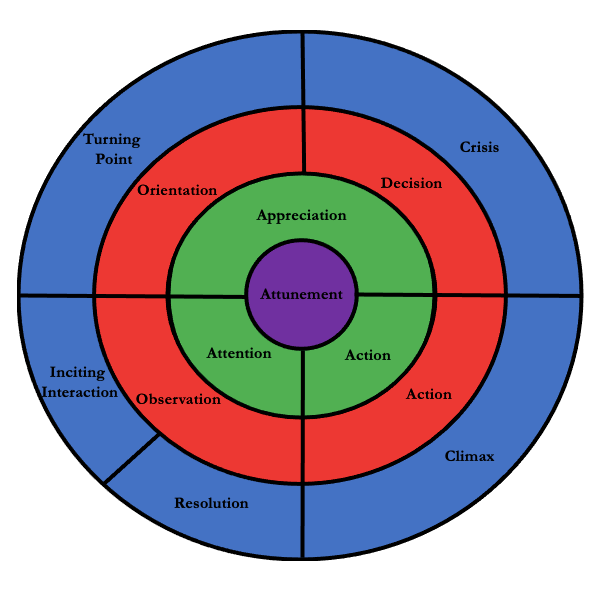
But what is the point of increasing your capability for free and independent action, as Boyd asserts? To what end? Why? OODA is a framework for prevailing competitively in a given domain. True, OODA can include cooperation, but it’s primarily meant for adversarial situations.
Boyd does talk about the moral dimension of conflict, alongside the mental and physical. For him, this includes things like shared values, trust, legitimacy, cohesion, and the ability to endure fear, uncertainty, and stress without coming apart.
What Boyd does not do is talk in an explicit way about the divine or sacred; when he uses language like “spirit” or a “grand ideal,” it’s usually about morale, ethos, and social cohesion rather than doctrine or worship. He was never trying to do this, so it’s not really even a fair critique of Boyd’s work.
With this model, I am trying to frame how humans connect to reality—how we harmonize and metabolize what life throws at us on a daily and lifetime basis. It’s about finding Flow not merely to win, but to be in accord with the transcendent. Whether we ground this in God, Tao, Nature, Source, or the Universe, the point is the same: we are not the measure of all things. I believe this assumption increases humility, reverence, restraint, sense of responsibility, and a focus on value.4
Attention
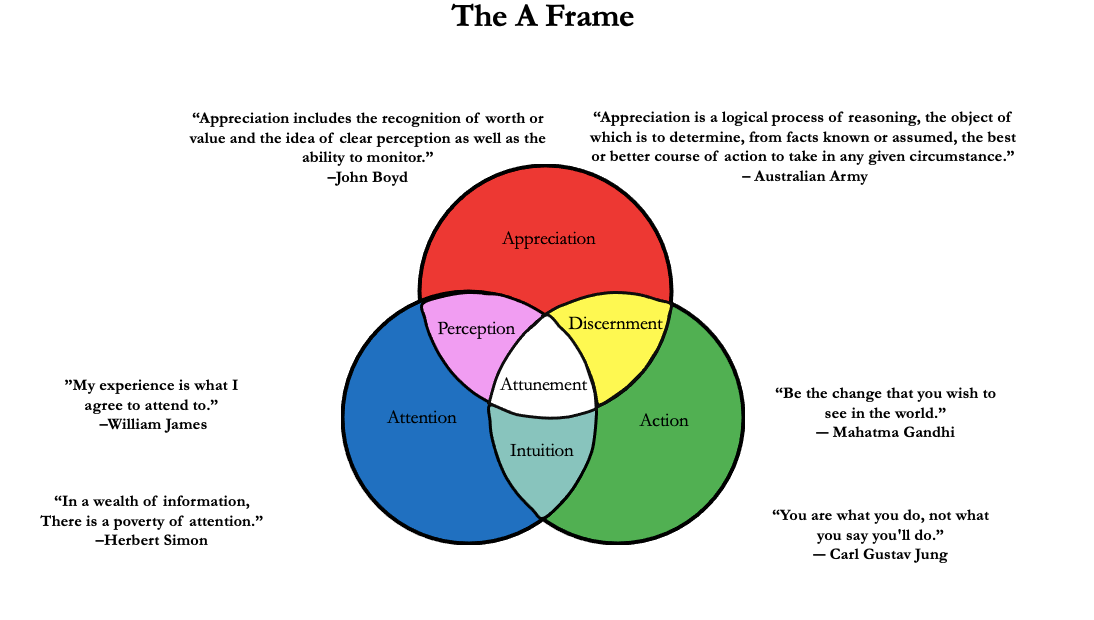
Attention is the application of awareness toward what matters in the moment—patterns, anomalies, and opportunities. In the A Frame, this is an active process that shapes what becomes notable to the agent, and thus what can be known and acted on. Iain McGilchrist calls attention a moral act, in that there are consequences to what we attend to.
Appreciation
Appreciation is the meaning-making and valuation mode: the point where we interpret what attention has gathered and judge its significance in context. It includes discernment, context-awareness, and appraisal—sorting signal from noise, weighing relevance, and identifying what the situation calls for. Appreciation is the bridge between perception and wise action, where understanding and value come together.
Action
This is the enactment of agency in the world—the move that turns perception and understanding into consequences. It is not only about achieving an objective, but also about generating feedback, because action reveals the environment and teaches the agent in a two-way exchange. Action is part of a living loop: each move updates what we can attend to and appreciate next, sharpening skill through engagement.
Attunement
“We are a way for the cosmos to know itself.” — Carl Sagan
“What opposes unites, and the finest attunement stems from things bearing in opposite directions, and all things come about by strife.” — Heraclitus
“Connection, the ability to feel connected, is neuro-biologically wired— that’s why we’re here!” — Brene Brown
Attunement is the result of repeated cycles of attention, appreciation, and action: a deeper fittedness or right relationship between agent and arena. It names a state of harmony, responsiveness, and “optimal grip” in which a person becomes more skillful, flexible, and grounded in the world they inhabit. Attunement is the telos, the purpose. Not simply faster decisions or tactical advantage, but a cultivation of coherence and wisdom.
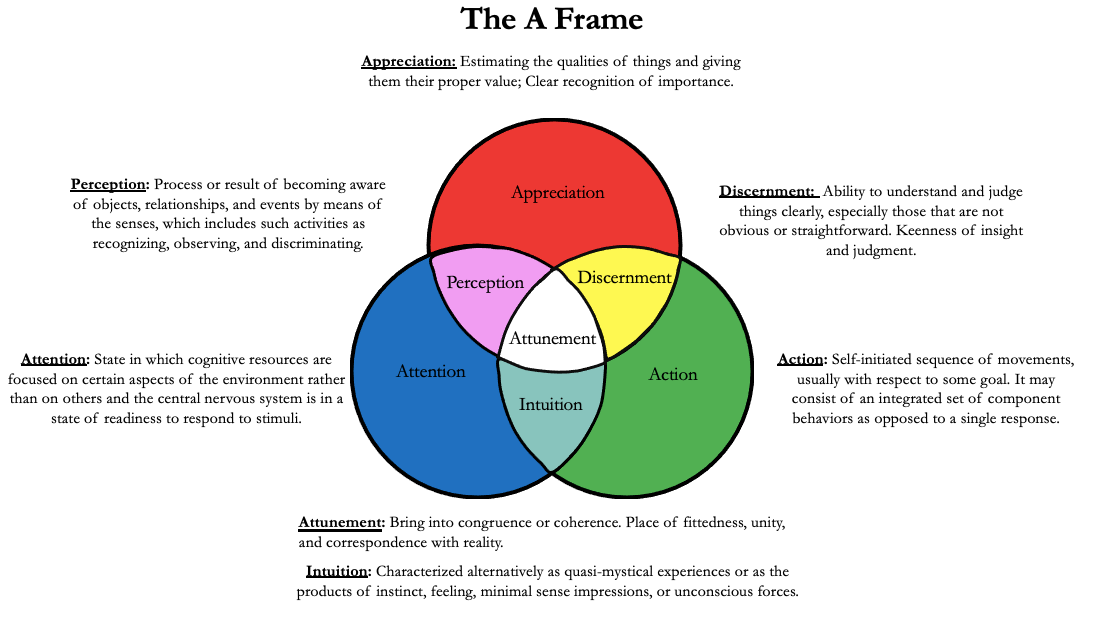
Why does this matter? The goal is to improve how we relate to reality, not just how quickly we make decisions. The process becomes developmental, not simply tactical, applying beyond competition and adversarial situations—to things like creativity, parenting, leadership, and spiritual formation. Places where the goal is not simply win faster but become more skillful, grounded, and responsive over time. It explicitly foregrounds what you notice, how we assign meaning and value, and feedback-generating moves.
In time, I will better understand specific ways humans attune, and develop a rubric for assessing how well we’re doing. Things like:
Accuracy: are our predictions improving?
Adaptability: do we recover quickly from surprise?
Coherence: are our values and actions less internally contradictory?
Relational attunement: do we track other minds better?
Somatic regulation: do stress and craving distort perception less?
My hope is this model helps humans become harder to manipulate, less likely to confuse noise for signal, and more capable of living in truthful contact with the world. That it can help avoid both fatalistic passivity and excessive controlling. It can help us notice better, interpret deeper, and act with wisdom.
Currere Certamen Tuum / Run Your Race
These three essays can be found here: Part I—The Agent, Part II—The Arena, Part III- Agency.
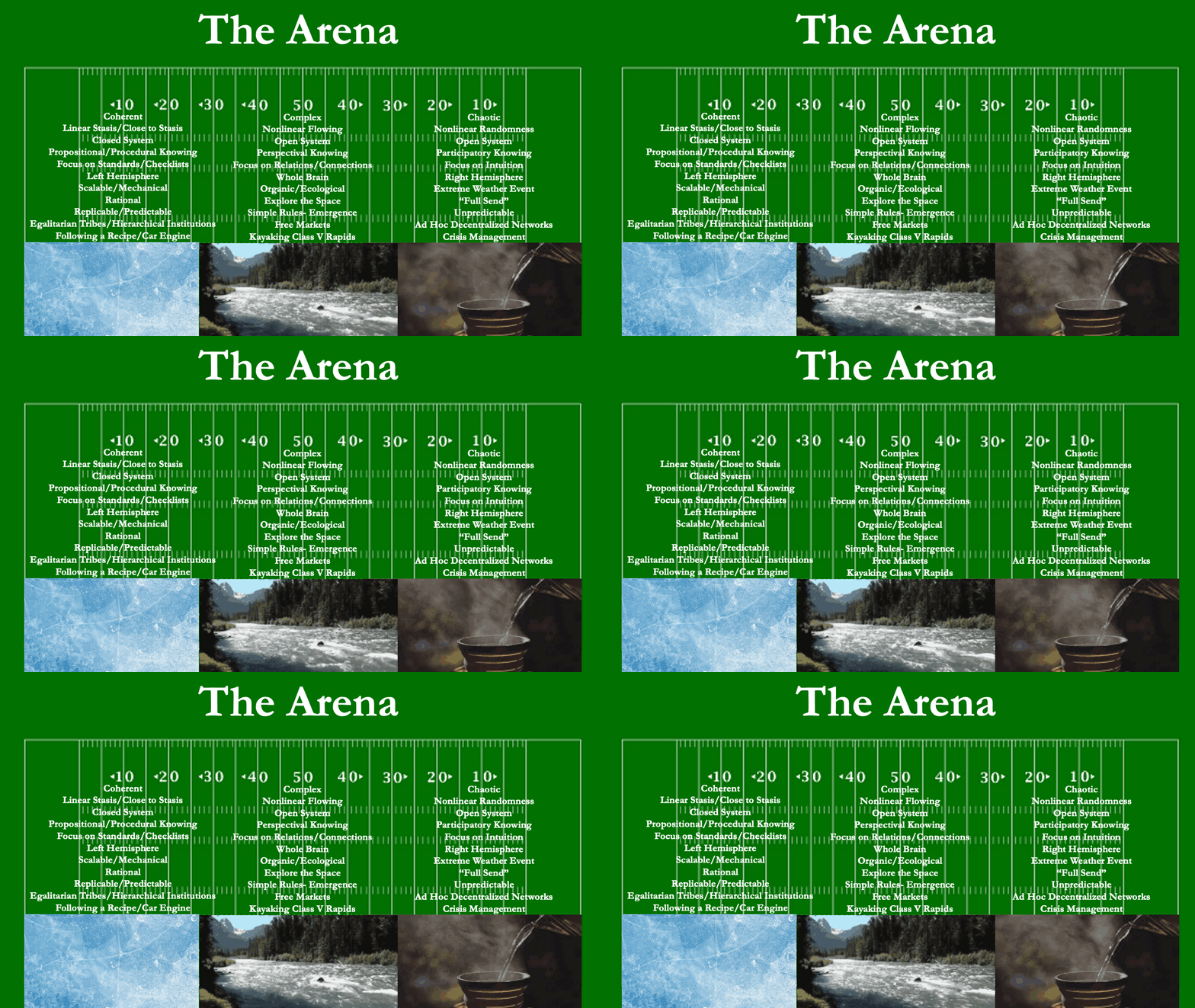
Here is an Arena chart I put together for Part II of my original essay series. It’s partially based on the work of thinkers Iain McGilchrist, John Vervaeke, Bonitta Roy, and internationally renowned curmudgeon David Snowden:
The A Frame is informed by the PCA model of Human Factors Design, The Dynamic Model of Situated Cognition, and Merleau-Ponty’s concept of Optimal Grip, among many others.
Not trying to smuggle in metaphysics—I mean to drop it on the table in all of its giant elephant glory. I discuss Brendan Graham Dempsey’s concept of value as embedded fractally in the universe here, which points toward a synthesis point between science and religion.
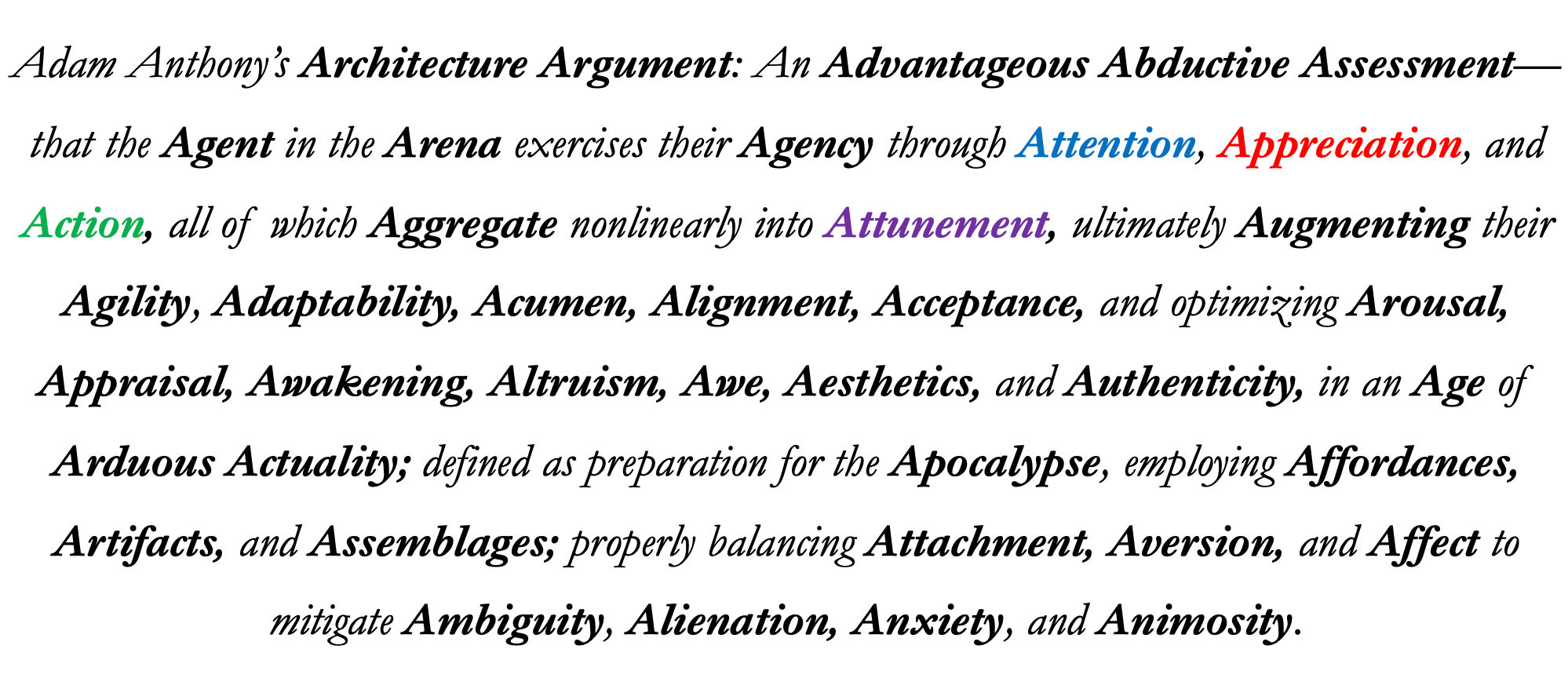
Glossary of Terms
Architecture— Unifying or coherent form or structure.
Argument— Coherent series of reasons, statements, or facts intended to support or establish a viewpoint.
Advantageous— Favorable; beneficial; profitable.
Abductive— Forming a conclusion from the information that is known.
Assessment— Act of judging or deciding the value, quality, important, or amount of something.
Affordances— Action defined in the relation between the Agent and the object.
Artifacts— Characteristic of and or resulting from particular human institution, period, trend, or individual.
Assemblages–- Combination or pattern of elements that produce effects in the world.
Agent— One that acts or has the power or authority to act.
Arena— Place or scene where forces contend, or events unfold.
Agency— Mode of exerting power; means of producing effects.
Attention— Act of close or careful observing or listening; ability or power to keep the mind on something.
Appreciation— Recognition of quality, value, significance, understanding, or magnitude of people/things.
Action— State or process of acting or doing; something that is done or accomplished; deed.
Aggregate— Collect or gather into a mass or whole.
Attunement— Bring into harmony or accord, related to Merleau-Ponty’s concept of Optimal Grip.
Augment— Make greater, more numerous, larger, or more intense.
Agility– Moving quickly/easily; nimbleness; Ability to think/draw conclusions quickly; intellectual acuity.
Adaptability— The ability to change (or be changed) to fit changed circumstances; suitability; fittedness.
Acumen— Exceptional discernment and judgment, especially in practical matters.
Alignment— Arrangement of groups or forces in relation to one another.
Acceptance—Non-judgmental awareness and embracing of thoughts, feelings, and sensations as they occur.
Arousal— State of physiological alertness and readiness for action.
Appraisal– Act of estimating or judging the nature or value of something or someone.
Awakening— Coming into awareness.
Altruism— Unselfish concern for the welfare of others; selflessness.
Awe— Emotion combining veneration and wonder that is inspired by the sacred or sublime.
Aesthetics— Dealing with the nature, expression, and perception of beauty, as in the fine arts.
Authenticity— Fidelity to one’s own personality, spirit, or character
Age— Period of time dominated by a central figure or prominent feature.
Arduous— Hard to accomplish or achieve; marked by great labor or effort; strenuous.
Actuality— Fact; reality.
Apocalypse— Revelation, disclosure; uncover, disclose, reveal; insight, vision; hallucination.
Attachment– Feeling that binds one to a person, thing, cause, ideal, or the like; devotion; regard.
Aversion— Avoidance of thing, situation, or behavior due to association with unpleasant/painful stimulus.
Affect– Produce an emotional response in (someone).
Ambiguity— Doubtfulness or uncertainty; capable of being understood in multiple senses or ways.
Alienation— Emotional isolation or dissociation; estrangement.
Anxiety— Uncertainty/fear resulting from anticipation of a real or imaginary threatening event/situation.
Animosity— Bitter hostility or open enmity.
Ok, I’m saving this one to re-read. Lots to try to wrap my head around. On the first pass, I’m struck by how aligned this is with the foundational principles of Stoicism- Impressions (how we perceive events), Judgements (what we choose to value), and Impulses (how we choose to act). Skillfully using each of these leads to eudaemonia/happiness/a smoothly flowing life. I’m really interested in the nuance described in your model.
Yes to all this brother. Elegant and eloquent.
If performance is potential leaving the model, and they are all sublime, especially liking attunement, then we need to come up with more than models. I know this is iterative, experimental, experiential, existential.
I feel we head towards model satiation though. Analysis and synthesis of what results we get from the models?
A time for a walk in the woods and drifting repose at your thoughts mate.
Flow well and well done